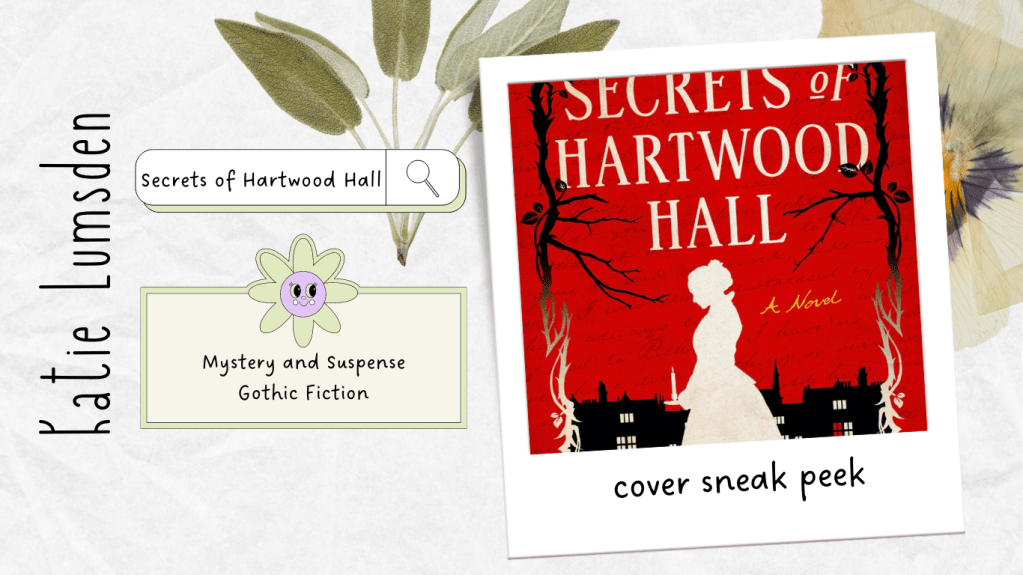
Synopsis
Nobody ever goes to Hartwood Hall. Folks say it’s cursed…**
It’s 1852 and Margaret Lennox, a young widow, attempts to escape the shadows of her past by taking a position as governess to an only child, Louis, at an isolated country house in the west of England.
But Margaret soon starts to feel that something isn’t quite right. There are strange figures in the dark, tensions between servants, and an abandoned east wing. Even stranger is the local gossip surrounding Mrs. Eversham, Louis’s widowed mother, who is deeply distrusted in the village.
Lonely and unsure whom to trust, Margaret finds distraction in a forbidden relationship with the gardener, Paul. But as Margaret’s history threatens to catch up with her, it isn’t long before she learns the truth behind the secrets of Hartwood Hall.
Synopsis from Kobo Canada.
Download From Kobo Canada
What I Think
Question 1. How would you describe the story?
When I was child, I love watching the cartoon series My Daddy Long Legs. I adore Judy Abbot, her benefactor, and her everyday antics. While immersed in this book, I kept thinking of that tv show from the 90s. And after finishing it, I realized why. As a child, it’s the closest thing I know of Victorian Europe with all the imposing turrets, flowing skirts, ruffles, and horse-drawn carriages even though My Daddy Long Legs was set in America.
The Secrets of Hartwood Hall is not gripping, as opposed to all the reviews that I’ve read before buying the book. In fact, it’s more like a bedtime story for adults. It’s eerie yes, but classic. I don’t read Emily Bronte and the likes, but this book gives the vibes. And how do I know that if I don’t read classics? Well, it’s My Daddy Long Legs. They have the same atmosphere, and a noticeable similarity in undertone.
Margaret Lennox is a recently widowed governess. Her husband died from a disease without leaving her anything. He was angry at her and had all sorts of accusations, which he wrote and confided to his mother before he passed away. And so without any money to her name, Margaret decided to go back to teaching, a profession she loved so dearly but was disappointingly kept away from by her husband. Ladies don’t work. He would say. Gosh, what would people think of him if he let his wife decide for herself and work like a commoner? Ladies don’t do that.
With a few reliable character references at hand, Margaret Lennox soon found herself employed at the Hartwood Hall house, with her employer Mrs. Eversham. She soon became friends with 10-year-old boy Louis, whom she is to home-school. Oh, how she adored Louis! His frowning eyebrows in Latin, his wide eyes in Arithmetic, Margaret found him adorable, and without a child of her own, grew to treat the young Louis as her own.
Then there is Paul, the gardener. Paul, who tended the flowers. Paul, who kept the grounds welcoming. Paul, who accompanied Margaret and Louis to church every Sunday. Paul, who took away Margaret’s logical reasoning. Paul, who let Margaret in his house for tea and afternoon chats. Paul, who Margaret fell head over heels for.
But despite her adoration with Louis, her respect for Mrs. Eversham, her delight in being a governess once again Margaret is bothered. There are curious footsteps in the dead of the night, missing food from the larder according to the housemaids, shadows in the East Wing when it should have been locked, decaying floorboards they told her. The East wing is a dangerous part of Hartwood Hall and no one is allowed. And why does the butler and cook seems to be hiding something?
And Paul. Paul is hiding something, not telling her, secrets of Hartwood Hall. But then again Margaret has her own too. Secrets from her past, on what really happened the night her husband died. She is torn, she wanted to push it, keep asking Paul until he tells her what she needs to know. But will she tell him hers, her past, her guilt, her own dark story?
Question 2. How would you describe the main character?
Margaret Lennox is supposedly a grieving young widow. But she is not. In fact, she is relieved, she has been set free from the marriage that suffocated her.
If I were to describe Margaret, I would say she’s a misfit of the Victorian era. She wants a purpose for her life. She wants to work and teach children, travel the city, stand on her feet, make her own decisions, plan her own future. Margaret does not want to be stuck with the label wife-of-a-pastor-therefore-no-ambitions. Because she has. She wants a fulfilling career, and not be kept inside the house like a porcelain china for display, nobody is allowed to touch.
Question 3. Besides the MC, who stood out the most?
Susan is a housemaid. She does not believe in ghosts, she said. I find Susan an interesting character. There is arrogance about her that disturbs Margaret. She walks the house like she makes the rules. She stares a lot, as if digging secrets from the eyeballs. She keeps her room locked at all times. She goes through personal letters. She likes knowing, prying on private things not meant to be pried. Susan is a character most readers will hate.
However, she stood out to me because she’s the second villain of the story. She’s a girl in her twenties with so much power, so much control. Susan holds the whole household at her fingertips. And if you read the book, you will come to know why.
Question 4. What is your red flag?
I’ll be honest, the red flag of this book is the way it’s written. It’s classic, and most casual readers I assume, appreciate and prefer a modern story telling. Personally, I don’t mind it though. I haven’t read any classics, except Rebecca by Daphne du Maurier if that can be considered as one. It is the oldest book that I’ve read published in 1938. If the older styles don’t bother you, then it isn’t a red flag.
Question 5. What is your green flag?

Well I give this book five stars!
The Secrets of Hartwood Hall is the longest book I’ve read, I think besides the last two books of the Harry Potter series, though I’m not 100% certain but it feels like is.
Imagine sipping a steaming earl grey on a fine spring afternoon when the flowers are in full bloom and the bees are busy, out and about sometimes passing by you. In your backdrop, we have an imposing residence plucked out from Andersen’s fairy tale book with ivy-laced towers and walls lined with floor-to-ceiling windows. In its center, there is a huge, heavy oak double door with a brass handle that’s sure to give a loud and booming thud, once it it hits the door.
And then in front of you is this wide, black lake, with soft waves crashing the shoreline, deep and mysterious. Beyond that, is a thick forest, overgrown with intertwined, aged, visible roots, and menacing crowns of branches that stretch and embrace each other, it’s impossible to see the boundaries.
I mentioned earlier that I didn’t find this book gripping, contrary to other book reviews I’ve read. Actually, I find it rather solemn like a funeral song for a dying bird.
I don’t know why I said that. But seriously, if you like a classic with two shots of goth, give this book a go.






 Missbehaving Books
Leave a comment